



Child Abuse Prevention Explained by Child Safety Experts: What Families and Communities Need to Know

Child abuse prevention isn’t just a conversation for April. It’s a responsibility we carry year-round. But Child Abuse Prevention Month serves as an important reminder: protecting children starts long before a crisis occurs. It begins with awareness, grows through education and is sustained by communities willing to show up for families in meaningful ways.
For many, child abuse can feel like a difficult or overwhelming topic, something hard to recognize and even harder to address. But prevention isn’t about having all the answers. It’s about understanding the factors that place families under stress, recognizing the signs that something may be wrong and knowing how to respond with care and confidence.
At KVC Missouri, prevention is more than a mission. It’s daily, hands-on work led by dedicated professionals like Director of Community-Based Services Michael Turner and Program Manager Danielle Mohrmann. Through their leadership at the Ozark Foothills Child Advocacy Center in Poplar Bluff, they are helping educate children, equip families and strengthen community partnerships to create safer environments where children can thrive. When families are supported and communities are engaged, prevention becomes possible — and every child has a better chance at a safe, healthy future.
Risk Factors of Child Abuse
When Danielle and Michael first started working with KVC Missouri, they both noticed that child abuse cases seemed to be dangerously on the rise in our communities. They knew something had to change, and that change started with identifying the co-occurring risk factors that increase stress on families in the area. Some of the most notable risk factors included:
- Substance abuse in the home
- Untreated mental health disorder in the home
- Economic strain
- Single-parent households
- Any household reliant on external childcare support
- Lack of caregiver education
- Caregivers who experienced child abuse themselves

While it’s important to recognize that these factors can increase the risk of child abuse, it’s important to note that correlation is not causation. Having one or more of these factors in the home does not guarantee an abusive situation. But understanding these factors is important for prevention because it helps us to intervene before a child is harmed.
Defining “Grooming”
What makes child abuse difficult to identify is the grooming that often accompanies it. “Grooming” in this context refers to the way abusers manipulate a child’s peers and the adults around them, making it difficult for children to seek help. Teachers, caregivers and every other support system a child has may choose to believe an abuser over a child, leaving the child feeling very isolated. To combat this pattern, children need to feel confident that there is an army on their side, advocating for them and protecting them.
Protective Factors for Child Abuse Prevention
Successful abuse prevention requires protective factors to wrap around families at risk, giving them support and empowerment to be stronger and more stable. These protective factors are the core values behind our child abuse prevention efforts at KVC Missouri.
Supportive Caregivers and Stable Relationships

Having the support of caregivers is foundational to both child abuse prevention and recovery. Even after abuse or a dangerous incident has occurred, a child’s future wellbeing is heavily dictated by whether or not they have supportive caregivers.
Beyond caregiver support for the children is relational support for caregivers themselves. A caregiver with stable relationships, whether from a spouse, their own parents or even a dedicated best friend, can go a long way toward empowering the caregiver and showing the child what stability looks like.
Education and Access to Resources
The more both parents and children in our community understand the risk factors and the red flags, the better equipped they will be to help prevent or report instances of child abuse. This goes beyond just “see something, say something.”
True education means providing realistic scenarios and scripts for nonconfrontational ways to address possible abuse situations, along with resources that children, families and community members can go to in trying times.
Community Support

“It takes a village to raise a child, but it also takes a village to abuse one,” says Danielle. While this may sound harsh, the reality is that every person who sees a child’s life may be complicit through their silence if a child is suffering. Coaches, teachers, parents, extended family and even siblings are all eyes on the child, and it is common to second-guess or ignore something, fearing the consequences of speaking up.
How KVC Missouri Strengthens Families Through Prevention
The unfortunante reality is that child abuse is happening in our communities and in our homes. KVC Missouri is hard at work educating children, families and communities on prevention and intervention using the Childhelp Speak Up, Be Safe program. With this program and other efforts in Missouri communities, we have educated more than 4,000 children and youth in the last year on how to protect themselves and what to do if they or someone they know is experiencing some type of abuse.
Michael Turner, Community-Based Services Director
“The Child Advocacy Center does not do it alone, and we can’t do it alone,” says Michael. “We can’t specialize in everything, so we have many wonderful partners that really surround the community.”

Here are some of the intervention and prevention services we provide and support at KVC Missouri:
- Child abuse prevention trainings on grooming, responding to warning signs and mandated reporting.
- School assemblies for children and youth on child abuse awareness and prevention.
- Community partnerships to address risk factors like economic concerns, children in foster care, substance abuse intervention and mental health treatment.
- Home visiting program for prenatal moms and moms of children up to age three as a baseline beginning prevention.
- School-based mental health treatment for children and youth.
- Behavioral and mental health treatment facilities throughout Missouri.
Sexual Assault Prevention in Poplar Bluff
The Ozark Foothills Child Advocacy Center (CAC) in Poplar Bluff does not convict abusers. They operate as a service that investigative parties like law enforcement may use, but first and foremost, they are a resource for children and families in crisis. Michael explains that children may come in and never disclose abuse, or there may never have been any abuse to begin with. “We rely on the child to be the expert in their story,” he says.

The CAC has several community engagement and outreach programs, but it has found the most long-term success through its work with Childhelp Speak Up, Be Safe. Using this curriculum, the CAC team goes into classrooms and holds assemblies, educating children and raising awareness around child abuse and related issues, like human trafficking and sexual assault. Educating children may make some adults uncomfortable, given the mature nature of this information, but it is vital that children understand their boundaries and feel empowered to keep themselves safe.
Michael saw the impact of this program on a personal level when his own children participated in the curriculum. His oldest was shocked by a story in which the perpetrator was a trusted adult who was in a position of authority to help the child. When asked if they really need to be looking out for people who are supposed to be helping, Michael explained, “We have to look out for everybody. You have to always keep yourself safe, no matter who you’re with.” This reality extends beyond adults, as 30% of child sexual abuse is perpetrated by other children. This curriculum helps protect children and teens by teaching them healthy boundaries and how to recognize abnormal sexual behaviors.
Go Blue Day 2026: Child Abuse Prevention Luncheon
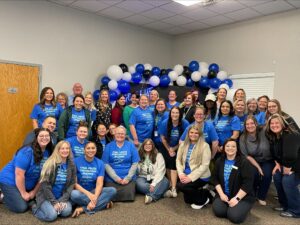
Go Blue Day 2025 Child Abuse Prevention Luncheon
In addition to the CAC’s ongoing efforts to prevent child abuse, the Go Blue Day 2026 Child Abuse Prevention Luncheon is coming up on Friday, April 10 and Fellowship General Baptist Church. This luncheon is a time to increase awareness around Child Abuse Prevention month, raise funding for our prevention programs and provide resources for community education.
We’re honoring the 140 Poplar Bluff team members who are the workforce behind all of our prevention and intervention efforts. We’re also selling Go Blue t-shirts with this year’s theme: Rooted in Community, in celebration of the 20-year accreditation anniversary of the CAC! Learn more here.
How Communities Can Help Prevent Child Abuse
Prevention happens every day, in every neighborhood, and it shouldn’t have to start with the children in abusive or high-risk situations.
Danielle Mohrmann, CAC Program Manager
“Society itself puts a lot of burden on a child to protect themselves,” says Danielle. “It’s everyone’s job to not place that burden on a child. We teach them how to protect themselves, but they shouldn’t have to. That’s an adult’s job, so let’s do it!”

Here are ways you can help prevent child abuse in your community:
- Offer support to families who may be overwhelmed
- Volunteer or donate to local organizations like the CAC or crisis shelters
- Educate yourself on the signs of child abuse
- Educate children on boundaries and privacy, digital safety and what-if scenarios
- Speak up if you suspect a child is in danger.
- Keep the conversation on child safety going!
Responsible Reporting

If you are concerned about a child and suspect they may be in danger, it is your job to report, not investigate. In Missouri, the best thing you can do if you are concerned about a child is to contact the Child Abuse Hotline.
Danielle explains that calling the hotline is anonymous and does not necessarily mean an immediate arrest. “They are trained to use their discretion,” she explains. “Even if it gets sent to a Children’s Division agency in your area, sometimes that just looks like offering a family assistance. Making a call doesn’t mean you’re getting people in trouble. It means that you’re literally helping.”
To report suspected abuse:
- Call the hotline at 1-800-392-3738
- Use the online reporting system at OSCR Missouri
- If it is an emergent situation involving real and immediate danger, call 911 immediately
Creating a Future Where Every Child Thrives with KVC Missouri
The CAC team likes to describe themselves as being worked out of a job every day. The goal may seem lofty, but every child educated and family supported is one more step toward communities where every child is safe and loved. Learn more about the Ozark Foothills Child Advocacy Center and what you can do to prevent child abuse.
